


Does a Kitchen Remodel ROI Increase Home Value?
Understanding kitchen remodel ROI is one of the most important financial considerations for US homeowners planning a renovation. A kitchen remodel is often the largest investment inside a home after roofing or major structural work, and it directly influences both buyer perception and resale price. In most US housing markets, kitchens are considered a “decision room” for buyers. This means the condition, layout, and finishes of the kitchen can heavily impact whether a home sells quickly or sits on the market. As a result, kitchen renovation resale value is often stronger than many other interior upgrades. However, not all remodels deliver the same return. The level of investment, material choices, and local market conditions all influence home improvement ROI. Some upgrades can significantly increase value, while over-customized or luxury-heavy remodels may not fully pay back at resale. This guide breaks down what actually drives kitchen value in real estate markets.
Understanding Kitchen Remodel ROI
Kitchen remodel ROI (return on investment) measures how much of your renovation cost you can realistically recover when selling your home. In the US housing market, kitchens are one of the most influential spaces affecting buyer perception, which is why they often deliver stronger returns compared to many other interior upgrades. ROI is typically influenced by three main factors: the total renovation cost, the quality of materials used, and how well the finished kitchen aligns with local buyer expectations. A mid-range remodel that improves layout, updates finishes, and adds functional kitchen upgrades for resale usually performs better than overly customized luxury projects. It’s also important to distinguish between personal enjoyment and market value. While a high-end kitchen may improve daily living, it does not always guarantee a proportional increase in modern kitchen value at resale. Ultimately, ROI depends on balancing cost efficiency with broad buyer appeal.

Average Kitchen Renovation Resale Value in the US
In the US housing market, kitchen remodel ROI varies widely, but most mid-range kitchen renovations tend to recover a significant portion of their cost at resale. According to long-standing industry benchmarks, homeowners typically recoup a meaningful share of their investment when updates align with local buyer expectations and avoid excessive luxury upgrades. A mid-range kitchen remodel, focused on updated cabinetry, countertops, lighting, and layout improvements, often performs better in terms of kitchen renovation resale value than high-end custom builds. Buyers generally prefer clean, functional spaces over highly personalized or overly expensive designs. In contrast, upscale remodels may improve lifestyle quality but do not always translate into proportionally higher resale returns. This is because home improvement ROI is strongly influenced by neighborhood price ceilings and comparable home values. Ultimately, the strongest returns come from balanced upgrades that modernize the kitchen without over-improving beyond the local market.
Highest ROI Kitchen Upgrades for Resale
When evaluating kitchen remodel ROI, not all upgrades contribute equally to resale value. In most US housing markets, the highest returns come from improvements that enhance functionality, modern appeal, and everyday usability rather than purely luxury features. Cabinet updates are often one of the strongest drivers of kitchen renovation resale value, especially when replacing outdated styles with modern options like shaker cabinets or clean flat-panel cabinets. Countertop upgrades, particularly to durable materials such as quartz, also have a strong impact on perceived value. Improving lighting, updating appliances, and optimizing layout efficiency can further increase home improvement ROI by making the kitchen feel more open and practical. Buyers are also drawn to neutral color schemes and well-planned kitchen upgrades for resale that require minimal immediate work after purchase. Overall, the best ROI comes from visible, functional improvements that align with current buyer expectations in modern US homes.
Low ROI Kitchen Improvements to Avoid
While a kitchen remodel can improve kitchen remodel ROI, not every upgrade delivers strong resale returns. Some improvements may enhance personal enjoyment but do little to increase kitchen renovation resale value in the broader US housing market. Highly customized design choices are often the biggest risk. Overly specific layouts, bold color schemes, or niche finishes can limit buyer appeal and reduce overall home improvement ROI. Luxury-grade appliances or exotic materials may also underperform in mid-range neighborhoods where buyers are not expecting high-end pricing. Another common mistake is investing heavily in layout changes that do not significantly improve functionality. Moving plumbing, gas lines, or structural walls can increase costs without a proportional impact on modern kitchen value. In general, upgrades that are difficult for future buyers to change or that exceed neighborhood standards tend to deliver lower returns compared to practical, broadly appealing improvements.
Modern Kitchen Value and Buyer Expectations
In today’s US housing market, kitchen remodel ROI is strongly influenced by what buyers expect in a “move-in ready” home. A modern kitchen is no longer considered a luxury, it’s a baseline requirement in many neighborhoods, which directly impacts kitchen renovation resale value. Buyers typically look for clean layouts, updated finishes, and functional storage. Features like modern kitchen cabinets, durable countertops, and energy-efficient appliances contribute to higher perceived modern kitchen value, even if the upgrades are relatively simple. Open layouts and improved lighting also play a major role in shaping buyer impressions.
At the same time, expectations vary by price range and region. In higher-end markets, buyers may expect premium finishes, while mid-range markets prioritize practicality and durability over luxury styling. This is why aligning upgrades with local standards is essential for maximizing home improvement ROI. Ultimately, modern kitchens sell faster because they reduce perceived future renovation costs for buyers.
Cost vs Value: What Impacts Remodeling Return on Investment
Understanding kitchen remodel ROI requires balancing what you spend with what buyers are actually willing to pay more for. The relationship between cost and value is not linear; spending more does not always guarantee higher kitchen renovation resale value. Several key factors influence home improvement ROI. First is scope: minor and mid-range remodels typically outperform high-end overhauls because they align better with local market expectations. Second is material selection, durable, widely appealing finishes like quartz countertops and modern kitchen cabinets tend to offer stronger resale appeal than highly personalized luxury choices.
Labor costs also play a significant role. In many US regions, kitchen remodeling benefits can be reduced when complex structural changes inflate budgets without adding proportional value. Layout efficiency, storage improvements, and energy-efficient upgrades generally deliver more consistent returns. Ultimately, ROI depends on strategic spending, investing in visible, functional upgrades that align with buyer demand rather than over-customization.
Regional Differences in Kitchen Remodel ROI
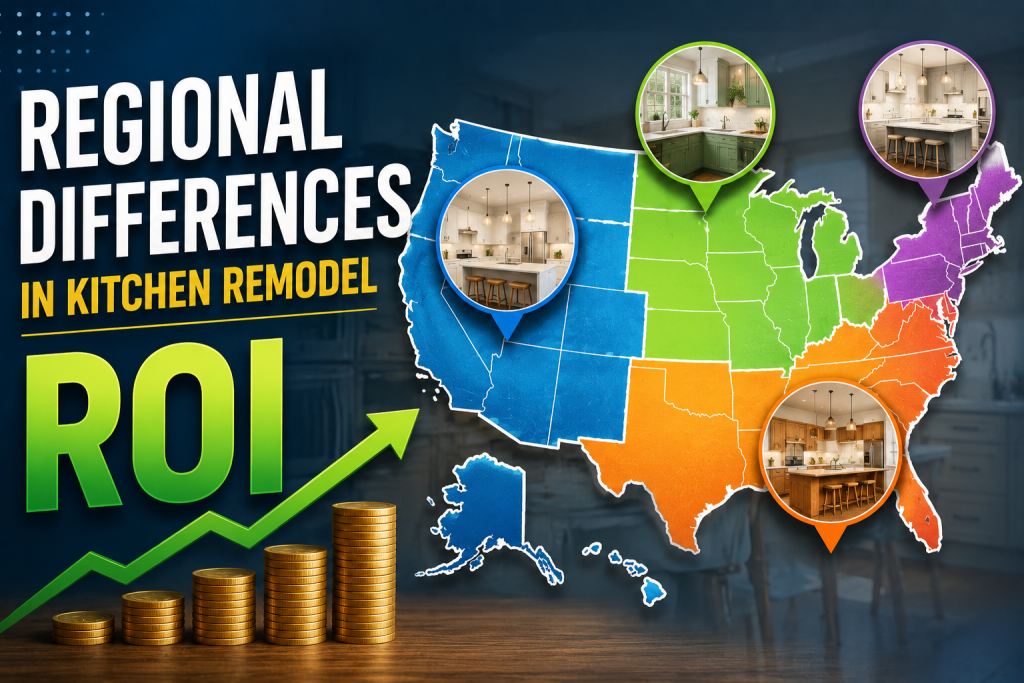
Kitchen remodel ROI is not the same across the United States, and location plays a major role in determining kitchen renovation resale value. Housing markets vary significantly by region, influencing what buyers expect and how much they are willing to pay for updated kitchens. In high-growth markets like Austin and Phoenix, home improvement ROI tends to be stronger because demand is high and buyers prioritize move-in ready homes. In contrast, cities like Los Angeles or Miami often see more design-driven expectations, where modern kitchen value is tied closely to aesthetics and premium finishes.
In more stable or mid-range markets such as Chicago or Atlanta, functional upgrades often deliver the best returns. Buyers in these areas typically prioritize practicality, durable materials, and efficient layouts over luxury features. Because of these regional differences, the same kitchen remodel can produce very different financial outcomes depending on local pricing trends and buyer expectations.
Is a Kitchen Remodel Worth It Before Selling?
Deciding whether a kitchen remodel is worth it before selling depends heavily on expected kitchen remodel ROI, local market conditions, and the current condition of the home. In many US real estate markets, the kitchen is one of the most influential spaces for buyers, meaning strategic updates can improve both speed of sale and kitchen renovation resale value. If the kitchen is outdated but structurally sound, minor to mid-range updates often deliver the best home improvement ROI. This can include refreshing cabinets, updating countertops, improving lighting, and modernizing appliances to align with current kitchen upgrades for resale expectations.
However, large-scale renovations are not always necessary before selling. In competitive or high-demand markets, buyers may prefer to remodel after purchase rather than pay for premium upgrades they may not value equally. Ultimately, the decision should be based on cost recovery potential, neighborhood standards, and how the kitchen compares to nearby listings.
Conclusion
A kitchen remodel ROI can be one of the strongest drivers of home resale improvements, but results depend on strategy, budget, and market alignment. Mid-range upgrades that improve function, layout, and appearance typically deliver the most reliable kitchen renovation resale value. Homeowners should focus on practical, widely appealing improvements rather than over-customization. When planned correctly, a kitchen remodel not only enhances daily living but also strengthens modern kitchen value and buyer appeal in competitive US housing markets.
FAQ About Kitchen Remodel ROI
What is the average kitchen remodel ROI in the US?
Most US homeowners can expect a moderate to strong kitchen remodel ROI, especially for mid-range renovations. The exact return depends on location, materials, and how closely the remodel aligns with local buyer expectations.
Does a kitchen remodel always increase home value?
Not always. While kitchen renovation resale value is generally positive, overly expensive or highly customized remodels may not fully recover their cost at resale.
What kitchen upgrades give the best ROI?
The best kitchen upgrades for resale typically include cabinet replacements or refinishing, quartz or durable countertop upgrades, improved lighting, and energy-efficient appliances.
Is it better to remodel before selling or after buying?
It depends on market conditions. In many cases, light updates improve home improvement ROI, but major renovations are often better handled after purchase when buyers can personalize the space.