


How to Dose Fertilizer for Plants: A Complete Guide to Safe Feeding
Knowing how to dose fertilizer for plants can make a major difference in plant health. Fertilizer provides nutrients that plants need for healthy leaves, roots, flowers, and fruit, but applying too much can cause just as many problems as applying too little.
The right fertilizer dosage depends on several factors, including the type of plant, fertilizer formula, soil condition, growing stage, application method, and the instructions on the product label. There is no single amount that works for every plant or every fertilizer.
For that reason, the safest approach is to understand the fertilizer label, identify the plant’s nutrient needs, measure the correct amount, and avoid the common mistake of assuming that more fertilizer means faster growth.
What Does Fertilizer Do for Plants?
Plants obtain nutrients from their growing medium, but available nutrients can become limited over time. This is particularly noticeable in containers, pots, raised beds, and intensively grown gardens.
The three major nutrients shown on most fertilizer labels are nitrogen (N), phosphorus (P), and potassium (K). Fertilizer labels list these in N-P-K order. For example, an 8-2-4 fertilizer contains 8% nitrogen, 2% phosphate expressed as P₂O₅, and 4% potash expressed as K₂O.
Each nutrient has a different general role:
| Nutrient | Main Role | Commonly Associated With |
| Nitrogen (N) | Supports leafy and vegetative growth | Green leaves and stems |
| Phosphorus (P) | Supports root development and reproductive growth | Roots, flowers, and fruit |
| Potassium (K) | Supports overall plant function and stress tolerance | General vigor and resilience |
However, N-P-K is only part of plant nutrition. Plants can also require secondary nutrients and micronutrients, and the best fertilizer choice depends on the growing medium and plant.
How to Read an N-P-K Fertilizer Label
Understanding the three numbers on a fertilizer bag or bottle is the first step in calculating fertilizer dosage for plants.
Suppose you have a fertilizer labeled 10-10-10. The numbers represent the fertilizer’s labeled percentages of nitrogen, phosphate, and potash respectively.
A fertilizer labeled 20-20-20 has the same relative N-P-K balance as 10-10-10, but it is more concentrated. Therefore, you cannot automatically use the same quantity of both products.
This is one reason gardeners should never choose a dose based only on the numbers printed on the front of the package. Always check the manufacturer’s application instructions for the particular product.
A soil test can provide an even better starting point for outdoor gardens because it helps identify which nutrients are actually needed. University extension guidance recommends using soil-test information when determining fertilizer requirements rather than applying nutrients without knowing the condition of the soil.
How to Dose Fertilizer for Plants
The easiest way to determine the correct fertilizer dosage is to follow these steps.
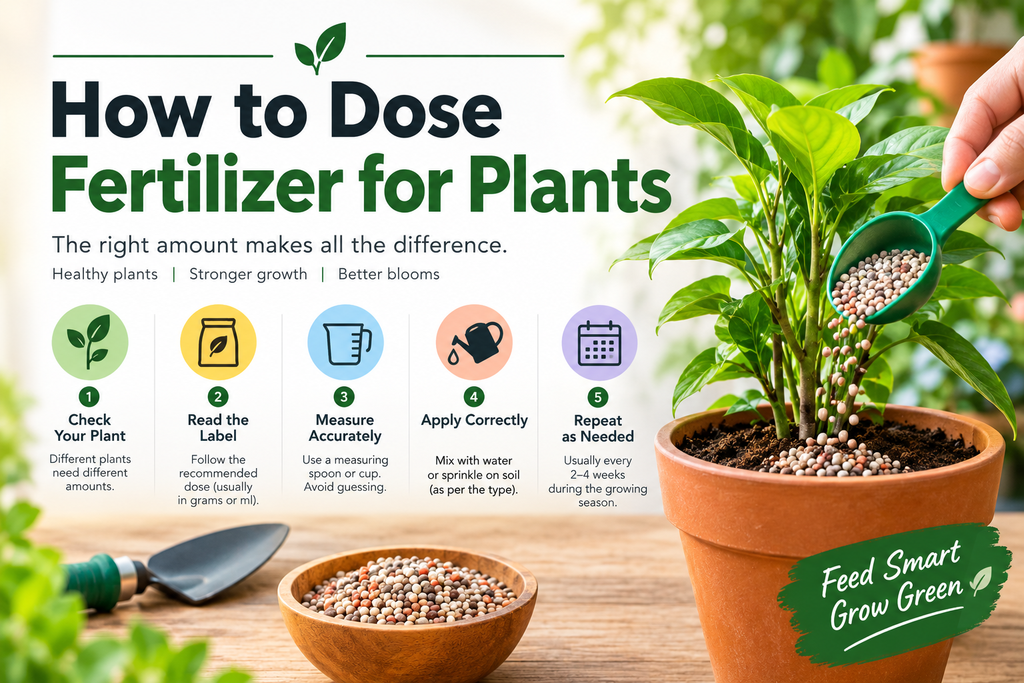
1. Identify Your Plant
Start by identifying what you are growing.
A houseplant in a small container does not have the same fertilizer requirements as a tomato plant growing in a large garden bed. Seedlings, mature plants, flowering plants, vegetables, trees, and shrubs can all have different requirements.
The plant’s growth stage also matters. A young seedling may require a much lighter feeding than an established, actively growing plant.
2. Check the Fertilizer Label
The product label should be your primary reference for the application rate.
Look for instructions such as:
- Amount per gallon or liter of water
- Amount per pot or container
- Amount per square foot
- Amount per plant
- Frequency of application
- Whether the product should be diluted
- Whether the fertilizer is intended for soil or foliar application
Do not assume that a dose recommended for one fertilizer automatically applies to another product.
3. Measure the Amount Instead of Guessing
Accurate measurement is important.
For example, if a liquid fertilizer label says to mix a particular amount with one gallon of water, calculate the amount according to the actual volume you are preparing.
A simple formula is:
Fertilizer required = label dosage × amount of water being mixed
For example, if a product calls for 1 gram per liter and you are preparing 5 liters, the calculation is:
1 g × 5 L = 5 g fertilizer
Using a kitchen spoon as a rough measurement can be unreliable because different fertilizer products have different densities. For dry products, weighing the material can provide a more consistent measurement.
How Much Fertilizer Should You Use for Houseplants?
Houseplants are particularly easy to over-fertilize because their roots are confined to a small amount of growing medium.
For indoor plants, conservative feeding is often preferable to heavy applications. Current gardening guidance commonly recommends diluted feeding for houseplants, while the exact dilution should still follow the specific fertilizer label. Some current guides suggest around quarter- to half-strength applications for many container plants.
A useful starting framework is:
| Plant Situation | General Approach |
| Established houseplants | Use a diluted fertilizer according to the product label |
| Young seedlings | Use a lower concentration unless the label says otherwise |
| Succulents and sensitive plants | Use conservative feeding and avoid unnecessary fertilizer |
| Recently repotted plants | Check whether the fresh potting mix already contains nutrients |
| Dormant or slow-growing plants | Reduce or stop feeding when the plant is not actively growing |
Do not treat these as universal replacement rates. Fertilizer formulations vary, so the product label and plant requirements should determine the final dosage.
How Often Should You Fertilize Plants?
How often to fertilize plants depends on the product, plant, growing conditions, and season.
Fast-growing plants may use nutrients more quickly than slow-growing plants. Similarly, plants growing in containers can have different requirements from plants growing in garden soil.
During active growth, plants may require regular feeding, while many plants need little or no additional fertilizer during periods of dormancy or very slow growth.
The important point is to follow the recommended interval on the fertilizer label rather than automatically fertilizing every time you water.
Over-fertilization can cause salt accumulation in the growing medium and may damage roots.
Liquid Fertilizer vs. Granular and Slow-Release Fertilizer
The type of fertilizer also affects how you should dose it.
Liquid Fertilizer
Liquid fertilizer is usually diluted in water before application. It can provide nutrients relatively quickly, but the concentration must be measured carefully.
Because soluble fertilizers are readily available to plants, excessive applications can increase the risk of fertilizer burn.
Granular Fertilizer
Granular fertilizers are applied directly to the soil. Depending on the formulation, nutrients may become available relatively quickly or gradually.
Always distribute granular fertilizer according to the product instructions rather than concentrating it directly against the plant stem.
Slow-Release Fertilizer
Slow-release products are designed to release nutrients over an extended period. Their application intervals can therefore differ significantly from those of liquid fertilizers.
Never assume that a slow-release product and a water-soluble fertilizer can be measured or applied in the same way.
When Is the Best Time to Fertilize Plants?
For many plants, fertilizer is most useful during active growth.
Applying fertilizer when a plant is actively producing leaves, stems, flowers, or fruit generally makes more sense than feeding a plant that is dormant or severely stressed.
Avoid using fertilizer as an emergency treatment for a plant that is suffering from drought, root damage, disease, or another serious problem. Adding nutrients does not automatically solve the underlying issue.
Before fertilizing, check:
- Is the plant actively growing?
- Is the soil adequately moist?
- Does the plant actually need additional nutrients?
- Has fertilizer already been applied recently?
- Does the product label recommend feeding at this stage?
Should You Fertilize Dry Soil?
Applying concentrated fertilizer to extremely dry growing media can increase the risk of root injury.
For many applications, it is better to avoid putting fertilizer onto bone-dry soil and then leaving the concentrated material around the roots. Water management should follow the product instructions, and granular fertilizer should generally be watered into the soil as directed.
The key principle is to avoid creating a highly concentrated pocket of fertilizer around the root system.
Signs of Too Much Fertilizer
One of the most common beginner mistakes is assuming that more fertilizer will produce faster growth.
It can do the opposite.
Possible signs of fertilizer stress include:
- Brown or crispy leaf tips
- Leaf-edge damage
- Wilting despite adequate moisture
- White or crusty deposits on the soil surface
- Sudden decline after fertilizing
- Poor root health
- Excessive vegetative growth in some situations
Salt buildup is especially relevant in containers because there is less soil volume and less opportunity for excess nutrients to disperse naturally.
If you suspect over-fertilization, stop feeding and evaluate the growing medium and drainage. For container plants, flushing the growing medium with plain water may help remove accumulated soluble salts when appropriate, provided the pot has adequate drainage.
Signs That a Plant May Need More Nutrients
Slow growth, pale foliage, or other nutrient-deficiency symptoms can indicate that a plant is not receiving enough of a particular nutrient. However, these symptoms are not always caused by fertilizer deficiency.
Problems with:
- Light
- Watering
- Root damage
- Soil pH
- Pests
- Diseases
- Poor drainage
can sometimes produce similar symptoms.
That is why adding fertilizer immediately is not always the correct solution. For outdoor gardens, a soil test can help determine whether nutrients are actually lacking.
How to Calculate Fertilizer for a Garden
For larger outdoor areas, fertilizer rates are often calculated based on the amount of nutrient required per area rather than simply using a certain number of spoonfuls per plant.
For example, if a garden recommendation calls for a specific amount of actual nitrogen per 1,000 square feet, the fertilizer’s nitrogen percentage can be used to calculate how much product is needed.
One extension example explains that a 12-11-2 fertilizer contains 12% nitrogen, meaning 12 pounds of actual nitrogen are present in every 100 pounds of product.
The general calculation is:
Fertilizer amount = Required nutrient ÷ nutrient fraction in the fertilizer
This approach becomes particularly important for larger gardens because using the wrong fertilizer quantity can result in significant nutrient over-application.
Common Fertilizer Mistakes to Avoid
| Mistake | Why It Can Be a Problem |
| Using more fertilizer than recommended | Can cause salt buildup and root or leaf damage |
| Ignoring the N-P-K ratio | May provide nutrients the plant does not need in the same proportions |
| Guessing the dosage | Can result in inconsistent feeding |
| Fertilizing stressed plants automatically | The underlying problem may not be nutrient deficiency |
| Applying fertilizer to very dry soil | Can increase concentration around roots |
| Ignoring soil tests for outdoor gardens | Can lead to unnecessary nutrient applications |
| Using the same dose for every plant | Different plants and growing conditions have different requirements |
University extension guidance also warns that repeated over-application of nitrogen and phosphorus can contribute to environmental and water-quality problems.
Final Tips for Safe Fertilizer Dosing
If you are still learning how to dose fertilizer for plants, keep the process simple:
- Identify the plant and its growth stage.
- Read the fertilizer label carefully.
- Check the N-P-K ratio.
- Measure fertilizer rather than guessing.
- Use the recommended dilution for liquid products.
- Avoid unnecessary applications.
- Feed during active growth when appropriate.
- Watch plants for signs of over-fertilization.
- Use a soil test for outdoor gardens when possible.
- Never assume that a higher dose will produce better growth.
Frequently Asked Questions
What is the best fertilizer dosage for plants?
There is no universal fertilizer dosage. The correct amount depends on the plant, fertilizer formulation, growing medium, and application method. Start with the manufacturer’s label instructions.
How often should I fertilize my plants?
Frequency varies by plant and fertilizer. Many plants need more nutrients during active growth and less during dormancy. Follow the recommended interval on the product label.
What does NPK mean in fertilizer?
NPK stands for nitrogen, phosphorus, and potassium. The three numbers on a fertilizer label indicate the labeled concentration of these nutrients in N-P-K order.
Can too much fertilizer kill plants?
Yes. Excess fertilizer can increase salt concentrations around roots and cause fertilizer burn or other plant damage. Soluble fertilizers can be particularly easy to over-apply.
Should I use liquid or slow-release fertilizer?
Both can work, but they require different application methods. Liquid fertilizer is diluted and applied more frequently in many situations, while slow-release products provide nutrients over a longer period. Always follow the specific product instructions.
Do I need a soil test before fertilizing?
A soil test is especially useful for outdoor gardens because it can show existing nutrient levels and help guide fertilizer decisions. It can reduce the risk of applying nutrients that are not needed.
Conclusion
Learning how to dose fertilizer for plants is less about finding one perfect number and more about understanding the factors that determine the right application rate. The plant species, N-P-K ratio, fertilizer type, soil condition, growing stage, and product instructions all matter.
The safest strategy is to measure carefully, follow the fertilizer label, avoid excessive applications, and use soil testing when appropriate. For houseplants and containers, conservative feeding can help reduce the risk of salt buildup, while outdoor gardeners can use soil-test results to make more informed nutrient decisions.
Most importantly, remember that fertilizer is a supplement, not a substitute for good growing conditions. Proper light, watering, drainage, healthy soil, and suitable temperatures all work together to produce healthy plants.